The following example of a PurposeMap™ report is based on a fictious person, Joe Purpose. It is based on his resume, his personality assessment, his strengths assessment and seven additional assessments about his identity and personal situation. For this example, Joe was a Marine Corps Cobra Pilot who transitioned from the military to now being a Pharmaceutical Representative. Joe is married with one child.
The example shows what you can expect from your Personal PurposeMap™.
Make sure you scroll to the Explainer Video and the Podcast
____________________________________________________________________________________________
Joe Purpose’s PurposeMap™ Identity Intelligence Synthesis
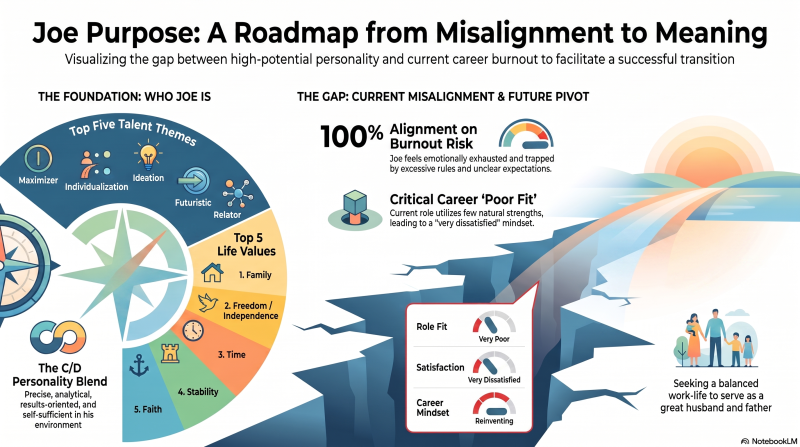
1. Integrated Identity Profile: The Core Architecture
An individual’s identity is not a collection of static preferences; it is the underlying operating system that dictates how they process reality, calibrate risk, and engage with their environment. For Joe Purpose, this architecture is experiencing a profound architectural misalignment. His identity is defined by a rigorous synthesis of traditional foundations and analytical validation, filtered through the high-stakes discipline of military aviation. At his current life stage—the “Establishing Career and Family” phase—this operating system is attempting to reconcile the duty of a “provider” with an urgent, nature-driven requirement for autonomy.
Identity Synthesis
Joe operates as a “Logical Traditionalist,” utilizing a sophisticated cognitive framework where tradition serves as the baseline and logic serves as the primary validation tool. He does not adhere to rules out of blind compliance; rather, he respects established systems only when they withstand logical scrutiny. This explains his visceral rejection of “excessive rules” that lack rational utility. While his self-perception is anchored in being a “traditional guy,” his internal settings are geared toward “Exploratory” risk and “Mostly Analytical” information processing. He is a Deep Processor who prefers a “Balanced,” measured approach to final decision-making, a trait essential in combat aviation where one must synthesize complex data sets before committing to a course of action.
Strategic Interpretation
Joe is currently caught in a structural paradox common among high-functioning veterans in mid-career transitions. As a former Company Grade Officer, his internal software is programmed for tactical execution and personnel management. However, his current life stage—marked by the financial pressure of family obligations—has forced him into a “transactional” hardware environment. The tension between his need for stability (to provide) and his desire for freedom (his #2 value) has reached a breaking point. He is trying to fulfill his “Provider” mandate by suppressing his “Leader” nature, resulting in a state of high-friction survival.
2. The Unique Gift: Natural Value Contribution
A “Gift” is a recurring pattern of value creation that represents an individual’s primary competitive advantage. For Joe, this gift is a direct extension of his aviation background and his natural cognitive wiring.
Gift Definition: Strategic Life Evaluation
Joe’s gift is the ability to provide Strategic Evaluation and Life Decision Advice. This is the “Aviation Briefing Mindset” applied to human systems. In combat flying, the “brief” is a sacred period of evaluating variables before acting to ensure mission success and the safety of the unit. Narrative evidence confirms that others consistently seek Joe out for this specific intervention: he stops and evaluates the landscape before the first move is made. He serves as a “Pre-flight Strategist” for the people in his orbit, protecting them from impulsive or ill-conceived actions through logical scrutiny.
- Confidence Rating: High. This theme is validated by his “Balanced” decision-making style and the specific narrative feedback regarding his tendency to “evaluate before acting.”
Strategic Interpretation
A profound discrepancy exists between Joe’s gift for “Strategic Evaluation” and his current role in Sales . The sales environment typically rewards rapid, intuitive, and highly social “closing” behaviors that prioritize volume over validation. Joe’s data indicates a “Very Poor Fit,” as he is being asked to operate at a “Rapid” pace that denies him the “Analytical” processing time he requires. Furthermore, the “Exploratory” nature of his risk preference is being stifled by the stable, repetitive metrics of a sales quota. He is being utilized as a transactional engine when his nature is that of a strategic architect.
3. Purpose Synthesis: The Enduring Contribution
Purpose is the enduring contribution that aligns an individual’s gift, values, and narrative. It serves as the Navigational Constant that justifies the effort of labor.
The Purpose Statement
“To serve as a disciplined provider and strategic guide, utilizing analytical clarity and traditional foundations to protect and empower my family while leading others toward logical, high-stakes stability.”
Evidence-Based Derivation
- Narrative Identity: His peak experiences (combat flying and family milestones) involve high-stakes responsibility where his actions directly protected or provided for others.
- Values Hierarchy: The non-negotiable prioritization of Family, Freedom, and Faith over achievement or money.
- Worldview: His reliance on “integrated sources” ensures his purpose is grounded in truth rather than abstract idealism.
Strategic Interpretation
Joe is currently experiencing a sense of profound isolation and “injustice,” noting that he “can’t find anyone to help me” define his purpose. This isolation is a byproduct of his “Independent” workstyle clashing with a current environment that does not recognize his “Company Grade Officer” leadership capabilities. Because he cannot identify a compelling “why” for his current sales activities, he feels he is “simply going through the motions.” For a man trained to operate in high-consequence environments, this lack of meaning is not merely a career frustration; it is an ontological drain.
4. Alignment Map & Burnout Risk Analysis
Alignment is the measure of how well daily activities support an individual’s nature. When alignment fails, the system enters a state of chronic depletion.
Alignment Classification: Critically Misaligned
Joe’s profile indicates a near-total system failure regarding environmental alignment. He is operating in a state where his core nature and his daily environment are in direct opposition.
Strategic Interpretation
The Burnout Risk Index has reached a terminal level. The 100% agreement on “fantasizing about escaping” and “feeling trapped” suggests that Joe is in a state of psychological rejection of his current path. His “nature” is actively signaling that this trajectory is unsustainable. The fact that “rest does not fully restore energy” indicates the drain is not physical exhaustion but a fundamental suppression of self. He is not tired from working too hard; he is tired of the person he has to be to do the work.
5. Career & Life Direction: Strategic Environment Fit
Joe’s future success is dependent on finding a “Nature-Aligned” environment that respects his military-honed discipline while providing the autonomy his exploratory nature requires.
Optimal Environment Profile
- Culture: Independent yet team-oriented—the “Squadron” model. He needs a unit of peers where responsibility is shared but tactical execution is autonomous.
- Pace: Balanced and Exploratory. The environment must value the “Analytical” process and allow for the evaluation of complex systems before action.
- Authority: High Autonomy. As a former Company Grade Officer, he requires an environment that values his “Strategic Evaluation” gift and grants him control over the “how” and “when” of his mission.
Paths to Avoid
Joe must avoid roles that are:
- Highly Political: Where “who you know” overrides logical data and proven systems.
- Procedurally Rigid: Where “excessive rules” are maintained regardless of their logical validity.
- Purely Transactional: Roles like “General Sales” that ignore his capacity for leadership and strategic oversight.
Strategic Interpretation
The current “Sales” role is a catastrophic mismatch. Joe’s “kick butt” work ethic (Source 9, Item 9) is likely masking the severity of this mismatch, as he is likely performing well despite the internal cost. However, the success metrics of sales do not reward his gift for “Strategic Evaluation.” He is being measured by “how much” he sells rather than “how well” he assesses the landscape.
Comprehensive Career Alignment Strategy for Joe Purpose
1. Strategic Assessment: The Narrative of the Candidate
Joe Purpose is currently operating at a profound deficit, navigating an acute professional crisis where his daily occupational reality is in direct opposition to his forged identity. As a former Combat Pilot and Company Grade Officer, Joe’s narrative identity is built upon analytical rigor, mission-critical leadership, and the high-stakes responsibility of a protector. In his current sales role, however, he is forced to maintain a “mask” of likability to facilitate a transactional environment.
While he is described as “well-liked” and a “hard worker,” these traits currently serve as a performance that facilitates “pretending to be someone I’m not.” For a professional of this caliber, aligning a career with Narrative Identity is not a matter of preference—it is a survival strategy to arrest the severe burnout evidenced in his assessment data.
Identity vs. Reality
| Core Identity Factors (The Internal Pilot) | Current Professional Reality (The Sales Friction) |
| Combat-Experienced Leadership: Proven officer (CGO) capable of leading teams in mission-critical contexts. | Underutilized Potential: Current role feels “meaningless”; feels more capable than the role allows him to demonstrate. |
| Analytical Decision-Maker: Relies on “Proven systems, data, and expertise” to determine truth and authority. | Misaligned Thinking: Forced to operate in a rapid, intuition-heavy environment that lacks logical evidence. |
| Protector & Provider: Foundational drive to be a “Great husband, father and provider” for his wife and son. | Unnatural Energy Drain: Spends significant energy suppressing important parts of himself to fit expectations. |
| Mission-Driven: Thrives when “serving a particular need or cause”; needs to see the impact of his work. | Transactional Context: “Simply going through the motions” in a role that does not reflect what he cares about. |
Foundational Internal Drivers
Joe’s motivation is anchored in a worldview where authority is derived from proven systems, data, and expertise. He is not a person who gambles on gut feelings; he analyzes and tests validity before acting. This explains his current state of “uncertainty”—without a system to trust or a mission to serve, he feels disconnected from his natural gifts. He is fundamentally a “Mission-Driven” professional who is ready to “kick butt” the moment he finds a purpose that justifies the effort.
Transitioning from this state requires a move away from environments that demand a false persona and toward those that respect his need for analytical oversight.
2. Diagnostic Analysis of Professional Friction
The environmental “drains” Joe is currently experiencing have reached a critical threshold. This is no longer a matter of temporary stress; the assessment data indicates a level of exhaustion and cynicism that is fundamentally unsustainable. He is currently operating in a context that, by his own admission, “brings out the worst version of me.”
Environmental Traps & Interpersonal Exhaustion
Joe’s professional friction is categorized by a lack of control and a high degree of “Interpersonal Exhaustion.” He reports “Strongly Agree” across every category of the Burnout Risk Index, specifically struggling with:
- Cognitive Misalignment: Sales requires a “Rapid” decision-making style based on social intuition. Joe is “Mostly Analytical” and “Deliberate.” Being forced to operate without “Evidence and Logic” acts as a constant cognitive drain.
- Environmental Restrictions: He feels trapped by “excessive rules” that limit his independent thinking and his ability to influence outcomes.
- Value Conflict: As a former officer, Joe is depleted by people who resist responsibility or engage in manipulative, political behavior. These traits contradict his military-bred integrity and his faith-based worldview.
The Burnout Risk Index: A Critical Threshold
Joe’s scores in emotional exhaustion and cynicism are not merely “high”—they are definitive. He feels “stuck despite efforts to improve things” and frequently “fantasizes about escaping.” The “likability” he maintains in sales is a strategic liability, as it masks the fact that his work style—which requires stopping and evaluating before acting—is being systematically suppressed. To continue in a role that requires him to ignore what he really wants is to invite total professional collapse.
Joe’s next move must be a strategic pivot toward a hierarchy of needs that honors his role as a provider and his identity as a logical leader.
3. The Career Selection Framework: Hierarchy of Needs
For Joe, the “Values Hierarchy” serves as a non-negotiable filter. Any role that fails to honor these top five priorities will inevitably result in the same friction he currently faces.
Top 5 Values & “So What?” Strategic Impact
- Family: So What? Joe’s highest priority is a “balanced work life” to enjoy his wife and son. Any role that demands excessive, unpredictable “crunch” time will lead to immediate identity conflict.
- Freedom/Independence: So What? He requires a “secure platform from which to take calculated, mission-oriented risks.” He needs the autonomy to execute tasks without over-surveillance.
- Time: So What? Joe needs agency over his schedule. Without the ability to manage his own time, he cannot fulfill his primary duty to his family.
- Stability: So What? This is a prerequisite for his role as “Provider.” Given his “moderate financial pressure” and “family obligations,” stability provides the psychological safety needed to perform.
- Faith: So What? Because his moral compass is anchored in “accepting Jesus as Lord,” any environment with ethical “gray areas” or “dishonesty” will trigger an immediate crisis of conscience.
Optimal Work Environment
Joe’s “Workstyle Preferences” reveal a unique paradox: he craves Stability but possesses an Exploratory risk profile. He does not want a stagnant role; he wants a mission where the risks are logical and the systems are proven. His ideal environment is:
- Analytical & Operational: Prioritizing data-backed decisions over social performance.
- Independent yet Collaborative: A “Team-Oriented” context where he is given the “Freedom” to lead his specific sector.
- Deliberate Pace: A context that allows him to “stop and evaluate before acting,” utilizing his natural cognitive strengths.
4. Targeted Career Recommendations & Strategic Fit
These “Alignment Paths” are not mere job changes; they are a return to Joe’s natural gifts, leveraging his experience as a Company Grade Officer to provide operational value.
Path A: Operations Director or Senior Project Manager
- Strategic Alignment: This role utilizes his “Mostly Analytical” nature and his strength in “evaluating before acting.” It moves him from the “Sales” front-end to “Operational” oversight.
- Values Check: Provides the “Stability” required for his family obligations and the “Independence” to manage complex systems.
- Military-to-Civilian Bridge: Directly translates his CGO experience in managing logistics and personnel into a corporate framework that prizes “Proven systems and data.”
Path B: Strategic Advisor or Operational Consultant
- Strategic Alignment: Joe is already consistently sought out for “advice on life decisions.” As an advisor, he can leverage his “deliberate” decision style to solve organizational problems without the drain of “Lead Generation.”
- Values Check: Offers maximum “Freedom” and “Time” control. It allows him to be a “Provider” while maintaining the “Balanced work life” he craves.
- Military-to-Civilian Bridge: Capitalizes on the combat pilot’s ability to assess high-pressure scenarios and provide logical, evidence-based solutions.
Path C: Specialized Aviation Management or Safety Oversight
- Strategic Alignment: This represents a “Returning to the Cockpit Mentality.” It puts Joe back in an industry where he felt “most alive,” but in a capacity that favors his need for analytical rigor over the physical act of flying.
- Values Check: Connects to his “Narrative Identity” while providing the industry-standard stability that supports his family.
- Military-to-Civilian Bridge: Uses his specific expertise as a combat pilot to lead safety programs or flight operations, where “Proven systems” are the absolute authority.
5. Tactical Transition Roadmap
Joe is currently in a season of “Preparing for a major transition.” To move from “Uncertainty” to “Stability,” he must execute a structured exit from his current environment.
Actionable Strategic Steps
- Conduct a “Provider-Minimum” Audit: Calculate the exact financial threshold required to maintain family stability. This allows Joe to stop chasing high-risk sales commissions and focus on roles that offer “Time” and “Stability.”
- Pivot Self-Directed Learning: Direct current “self-directed learning” toward certifications that validate his analytical strengths, such as the Project Management Professional (PMP) or specialized Aviation Safety credentials.
- Target “Data-Driven” Organizations: Actively avoid “Intuition-heavy” industries. Seek companies that value the “deliberate” and “logical” decision-making of a veteran officer.
- Leverage the Veteran Network: Connect with former pilots in operational leadership. Focus the conversation on “Operational Oversight” and “Strategic Advice” rather than sales-related roles.
Navigating Transition Pressure
Joe’s “moderate financial pressure” is a reality of his “Building a family” life stage. However, the current path is unsustainable. By treating this transition as a mission—using his analytical style to test new paths through informational interviews—he can mitigate the “uncertainty” of the change.
Final Outlook
Joe Purpose is not someone who needs to be reinvented; he is someone who needs to be redeployed. He is ready to “kick butt”; he simply needs the right terrain. By moving into a role that honors his analytical rigor and his history as an officer, he will fulfill his ultimate goal: being a “Great husband, father and provider” who leads with purpose and integrity.
6. Action Plan: Staged Implementation
Phase 1: 30–90 Days (Stabilization)
- Protect “Provider” Assets: Because “Family Obligations” are his greatest financial pressure, Joe must maintain his current role as a vehicle for stability. However, he should shift to a “maintenance level” mindset to preserve energy for the transition.
- Network Re-Branding: He must stop articulating his value as a “Salesperson” and begin positioning himself as a “Strategic Lead” or “Operations Analyst.”
- Boundary Construction: Establish strict “non-negotiable” hours for family and spiritual life to mitigate the “emotional depletion” of his current role.
Phase 2: 3–12 Months (Transition)
- Target Leadership-Operations Roles: Seek positions such as Director of Operations, Strategic Lead, or Technical Project Manager. These roles leverage his Company Grade Officer experience (tactical execution + personnel management) and his gift for strategic evaluation.
- Leverage the Veteran Infrastructure: Re-engage with high-level veteran networks specifically looking for “Operational Leadership” rather than entry-level corporate roles.
- Consultative Shift: If internal to his current company, propose a shift toward a “Sales Operations” or “Strategic Advisory” role where he can fix the systems rather than just running the treadmill.
Phase 3: 1–5 Years (Legacy)
- Build the “Provider” Fortress: Transition into an environment where “Freedom” and “Time” are the primary rewards of his labor.
- Legacy Realization: Move into a position of mentorship where he can serve as the “Great husband, father, and provider” he envisions, utilizing his career as a tool for his family’s stability rather than a drain on it.
- Final Statement of Potential If Joe Purpose aligns his relentless work ethic with his natural gift for strategic evaluation and his identity as a tactical leader, he will evolve from a depleted producer into a high-impact architect of stability for his family and his organization.
Joe Purpose Explainer video
Joe Purpose Personal Podcast